Pedro Sousa Silva's research focuses on the intersection of historical music theory and performance practice, with a particular interest in Portuguese polyphony of the Renaissance. His doctoral dissertation, completed at the Universidade de Aveiro, proposed a model for the interpretation of Renaissance polyphony grounded in sixteenth-century treatises and their practical implications for performers today.
A significant part of his work involves the recovery of unknown or neglected repertoires from Portuguese archives. This includes the editing and preparation of musical sources for performance and publication — work that has resulted in editions of music by Francisco de Santa Maria, Vicente Lusitano, and others, several of which are freely available through IMSLP.
He is an Integrated Researcher at CESEM (Centre for the Study of the Sociology and Aesthetics of Music) and coordinator of its Porto-based branch, CESEM–P.Porto. He has participated in international research projects including Lost & Found (PI: João Pedro d'Alvarenga), the Hieronymite Plainchant Project (PI: Océane Boudeau), Chanter les Motets (HEM Genève, coord. David Chappuis), and Towards a Recorded Anthology of Portuguese Renaissance Music. Within the COST Action EarlyMuse — Early Music in Europe, he serves as Stakeholders' Coordinator and co-leader of the Working Group on Performances. He has presented his work at conferences including the International Medieval and Renaissance Music Conference (Munich, 2023) and the Lost & Found Conference (Cascais, 2023).
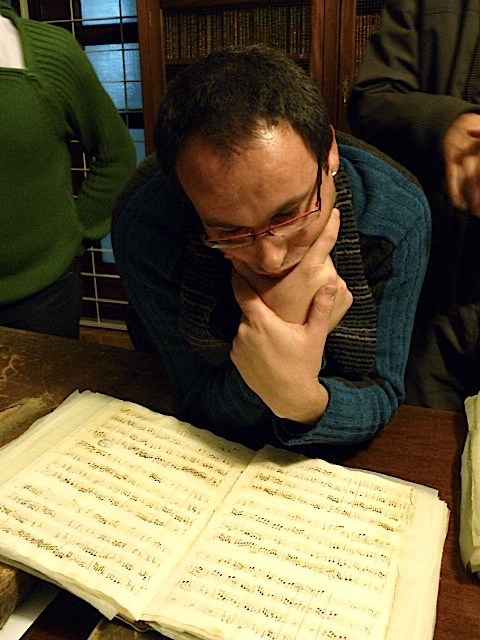
Photo: Sofia Pinto