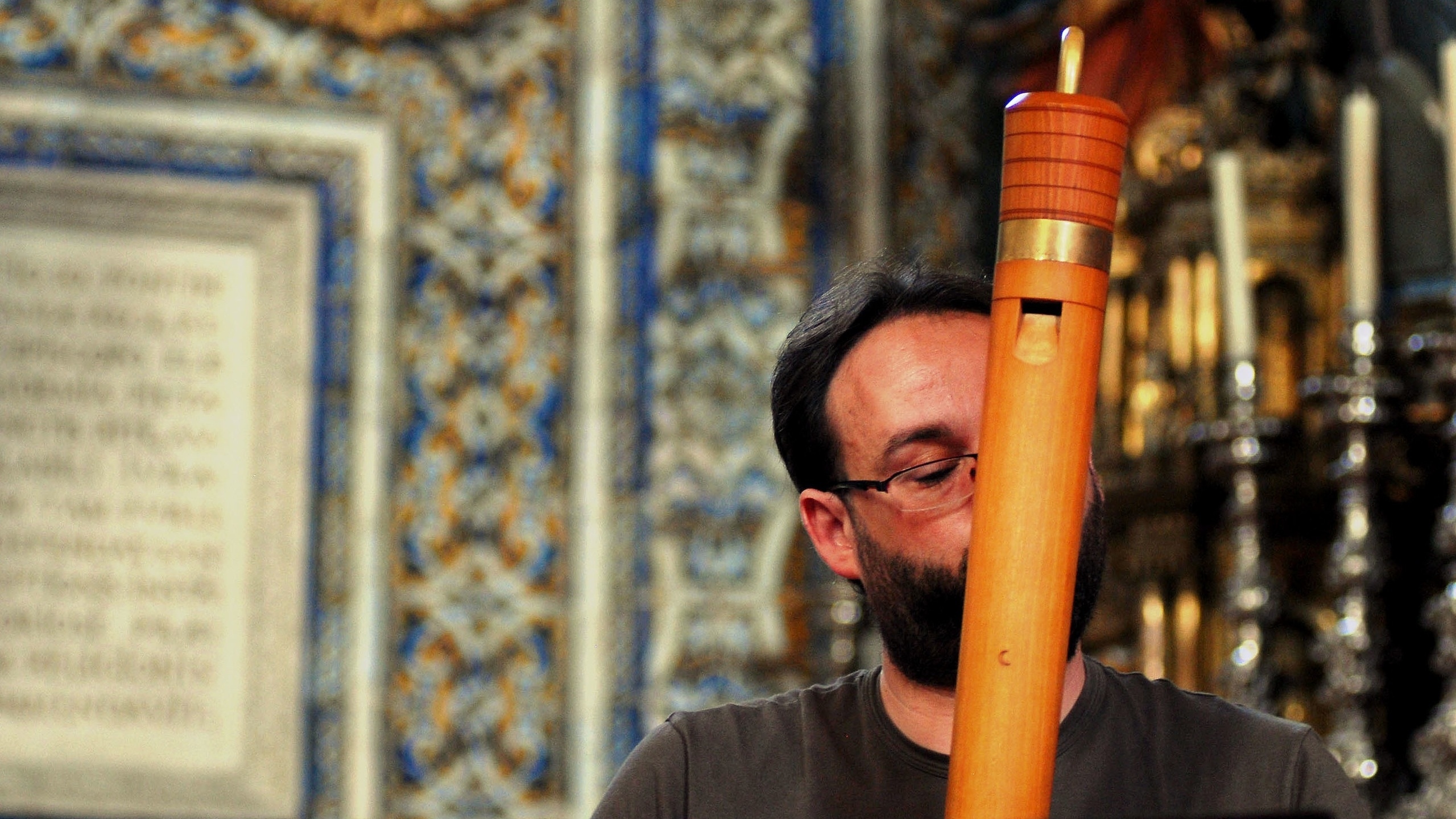
Pedro Sousa Silva
Photo: Ana Pereira
Pedro Sousa Silva is a recorder player, ensemble director, researcher, and professor, dedicated for more than twenty-five years to the medieval, Renaissance, and Baroque repertoires. He studied recorder with Pedro Couto Soares at ESML and with Pedro Memelsdorff at the Civica Scuola di Musica di Milano, graduated in musicology from the Universidade Nova de Lisboa, and holds a doctorate from the Universidade de Aveiro on the relationship between theory and practice in Renaissance performance.
Performance, research, and teaching are, in his practice, rarely separate activities. The same questions that drive his work on the concert stage — how Renaissance music was heard, theorised, and embodied — inform his research at CESEM and his teaching at ESMAE. Conversely, the work in the archive and the seminar room feeds directly back into the interpretive choices made in rehearsal.
As a performer, he has given more than two hundred concerts across Western Europe and Brazil, appearing as soloist at venues such as the CCB, Casa da Música, Palau de Música Catalana, and the Concertgebouw in Bruges. He divides his performing activity between Arte Minima — the ensemble he founded in 2011, focused on Portuguese music of the sixteenth century — Gli Incogniti (dir. Amandine Beyer), Capella Sancte Crucis (dir. Tiago Simas Freire), and the medieval ensemble Vozes Alfonsinas (dir. Manuel Pedro Ferreira).
As an Integrated Researcher at CESEM and coordinator of the CESEM–P.Porto pole, he participates regularly in international research projects on early music. At ESMAE/IPP, where he is Coordinator Professor, he co-founded the Early Music degree and directs the Advanced Studies in Polyphony postgraduate programme. He is the coordinator of the recently created doctorate in Music — Artistic Practices in the Portuguese Context, and director of the ESMAE Doctoral School. He is regularly invited to teach masterclasses and seminars at institutions including the Schola Cantorum Basiliensis, the Universität für Musik Wien, the Koninklijk Conservatorium Brussel, and the Conservatoire Supérieur de Lyon.